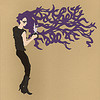
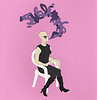
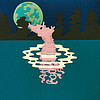
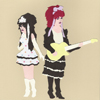
SHOULD Brevity of length be a virtue by which artist's statements ought abide, it may well be sufficient to write thusly:
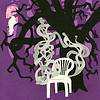
I make my own world and I give form to my world through my work. It has a lot of forests and seas and there is lawn furniture everywhere and everybody gets sick. Nobody can really communicate but to make convoluted puns. Nobody understands anybody else too well. Visions don't need visionaries, they occur on their own. All of the art that is made is absurd and redundant to look at because everything is already so bewildering, so they try to make jokes instead. There is a very famous book about a man with an upside-down face that nobody has read, but still it is very important to everybody. It is known for a significant quote, "Man created God in His own image." Everybody knows they are in a narrative but that it's somebody else's. Everybody is probably afflicted with Asperger's syndrome, but they probably don't know it because there is nobody who isn't to diagnose them. Everybody is in love with somebody but also nobody is in love with anybody. It is too difficult for everybody, somebody, anybody, and nobody to understand who they are and what "they" means. To wonder about it is very exciting though, and gives existence its meaning.
It is an expectation, if not a mere hope, however, that further exposition beyond the internally and subjectively visceral, perhaps initially oral but ultimately textual, will be generated from any given body of creations such as that assembled for an exhibition of pictures. And it is well to observe that the apparently auxiliary nature of such expository or interpretive texts to that which they address may in actual fact be a falsehood; such foreign articles clearly possess a far greater potency in the determining of both the
individual and personal as well the
collective and cultural understanding of a work or a body of work than we would like to admit, a fact attested to in the common reading of sundry statements and essays bearing little or no relation to the actual art that they state. The disillusionment the student of art may suffer at the realization that the map has come to exceed the territory may be either assuaged or intensified by the maxim professed by Donald Davidson:
"Nothing can count as a reason for holding a belief except another belief."
Whether or not the belief, the value, and the choice may refer to discrete mental processes, if we take the three as contingent upon one another, the art-maker may find a practical wisdom in the above statement. Rationalized beliefs are a matter of choices, which are determined by values, which in turn foreground what is
accepted as rational. All things of a worth beyond the material, perhaps even the
possibility of such worth, can most likely be rationalized into nothingness. To do so in any event is an act that is underlied by a simple value judgment, namely something like that abstractions objectified as words are the primary constitution of things with which we ought to concern ourselves.
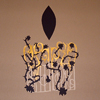
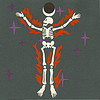
The term "pathetic fallacy," which was intended to loosely serve as a keynote and to, hopefully, set the timbre for the works assembled here to my intended pitch, possesses a charm on one account for the inevitable misunderstanding it will elicit, as a somewhat obscure and arcane term coined by John Ruskin, a critic and social theorist of a precisely dated sensibility, whose foundational
sage certainty on which he based the entirety of his output has long been out of fashion. Apart from this, there is a utility as well in Ruskin's intended meaning of the term:
the fallacy of supposing empathy. Ruskin, being concerned with a notion of art as something that derives from scientific observation of what is, specifically applies this term to the human portrayal of non-human objects of nature. This applies much more generally in my work, however, to empathy with
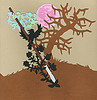
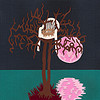
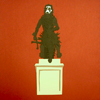
anything. John Ruskin himself is as well, to these ends specifically, a keynote of this exhibition. In addition to valuing in art-making the representation of nature's inherent truth with a fidelity attained by direct scientific observation, Ruskin also believed that the art made should in turn serve to represent the freedom and moral character of the art-maker. It is on precisely these grounds, for instance, that Ruskin bestows the highest of evaluations upon the Gothic period of architecture in Northern Europe, in which he saw the total freedom allotted to each craftsperson involved in the construction thereof. Taking this into account, it is hardly a surprise, the extent to which the biography of Ruskin himself, as the person possessing the moral character with which his incredibly lyrical and lucid writing and art should thus be imbued, has been a compelling subject, in no way restricted to mere footnotes. Indeed, I have attempted in some of my pictures here to empathize, most likely fallaciously, with this eccentric and complicated character, although what is most clear is the difficulty of both experiencing and expressing this empathy, which seems best-practiced through particularity of sensibility and symbolism. Suffice to say it is in its relation to the question of
being human that the character of Ruskin is ultimately most compelling.
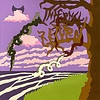
That the fall into being resulted from the choice to the Tree of Knowledge is shown by Cioran in
The Tree of Life to be, if nothing more, a parable of wise and keen understanding of the human character, and the plight that derives from whence. And herein lays another keynote of this assembly of pictures. The plight of human existence is that, afflicted with a primordial curiosity, knowing precedes living, while the tools we develop in order to know prove doubtful, themselves as inherently likely to negate as to affirm. We are then further compelled by the notion of we, in an attempt to validate knowledge through induction. But here too, our tools seem little more effective when we set to this task. The aporia inaugurated by Socrates in his corruption of the youth of Athens it seems has served as the animating principle in a teleology of ironic self-awareness, leading ultimately to the bewilderment of post-history.
A modest smattering of aphorisms could serve to elucidate the existentialist thread in the pictures hanging here, such as Kierkegaard's assertion that "the supreme paradox of all thought is the attempt to discover something that thought cannot think." The most concise wisdom to which I have been privy however occurs to me must be that of Flipper:
I, too, have sung death's praises,
But I'm not gonna sing that song anymore
Because I've found out what living's all about and it's life
Life is the only thing worth living for
In attempting to become alternately more human and less human, the quality that indulges in temptation to knowledge may be overcome in favor of the Tree of Life. Still, at the risk of becoming incessant and pleading, I attempt to verbalize, for hope there is a light visible that will illuminate the sublime text so sought by Bas Jan Ader, asserted in his film
I'm Too Sad to Tell You:
"[...]"
This work may better be understood as having been produced in reverence and tribute to the work and Spirits of John Ruskin, Emil Cioran, and Bas Jan Ader, with the guidance of David Tibet, King Diamond, and the Book of Revelation.
notes for "Pathetic Fallacy" gallery talk
home